
Kautenbach during the war
Resettlements, a destroyed church, blown-up bridges and a crashed bomber: Kautenbach was hit hard in the Second World War – and rebuilt itself after 1945.
In March 1941 the municipal administration of Kautenbach is dissolved and the village placed under the district mayoralty (Amtsbürgermeisterei) of Wiltz. After the general strike of August 1942, people considered politically “unreliable” are resettled. In Kautenbach these are Mathias Bantz, Michel Gottal, Suzanne Gottal-Frederes, and Marguerite and Lucie Gottal. Although not affected himself, Alex Gengler, Marguerite Gottal’s fiancé, voluntarily has himself arrested so as not to leave his fiancée alone.
On 10 July 1943 the order is issued to resettle the relatives of Wehrmacht deserters. In Kautenbach this affects the Aubart, Kneip and Zeyen families. Other Kautenbach residents ‒ Michel Aubart, Anton Heischburg, Jean-Baptiste Laplanche and Henri Hiertz ‒ are already being held in prisons. Four people are sent to a concentration camp: Michel Aubart, Helène Hiertz, Jean Laplanche and Suzanne Schartz. The latter is sent to the Eberswalde subcamp, where she is forced to do slave labour and dies. Seven other civil servants and workers from Kautenbach who refuse to collaborate are drafted into the service of the Reich.
In September 1944 Luxembourg is liberated and the war seems to be over. The euphoria is followed by disillusionment, for on 16 December 1944 the Battle of the Bulge begins. When the Kautenbach schoolchildren go home on 16 December, the adults are standing together in groups: “They’re crossing the Our, they’re not far away now …” On Sunday comes the news that German soldiers are in Holtzthum. GIs march from Kautenbach to Consthum. The people of Holtzthum, Consthum and Schlindermanderscheid flee the thunder of the guns.
Almost everyone from Kautenbach joins them. Only about twelve people stay behind.
On 17 December, German soldiers of the 14th Parachute Regiment of the 5th Parachute Division march into the village from the south, from the direction of Goebelsmühle, along the railway line. They capture the station, take the stationmaster prisoner, suspect treachery everywhere and plunder his supplies. Then they move into the village with their horses.
The American soldiers of the 103rd Medical Battalion have to abandon their aid station in Kautenbach in haste. When Lieutenant Daniel B. Strickler and his men withdraw from Consthum to Kautenbach on 18 December, they do not know whether the enemy has occupied Kautenbach or whether the escape route to Wiltz is still open. When they arrive in Kautenbach, the village is deserted.
The American soldiers pass through the village and are attacked on the bridge by German soldiers advancing from the tunnel. They manage to fend off the attack but cannot defend the isolated position in Kautenbach.
The school is turned into a stable for horses. Until the reconstruction of their destroyed village begins, the returning refugees have to live in a bunker at the station.
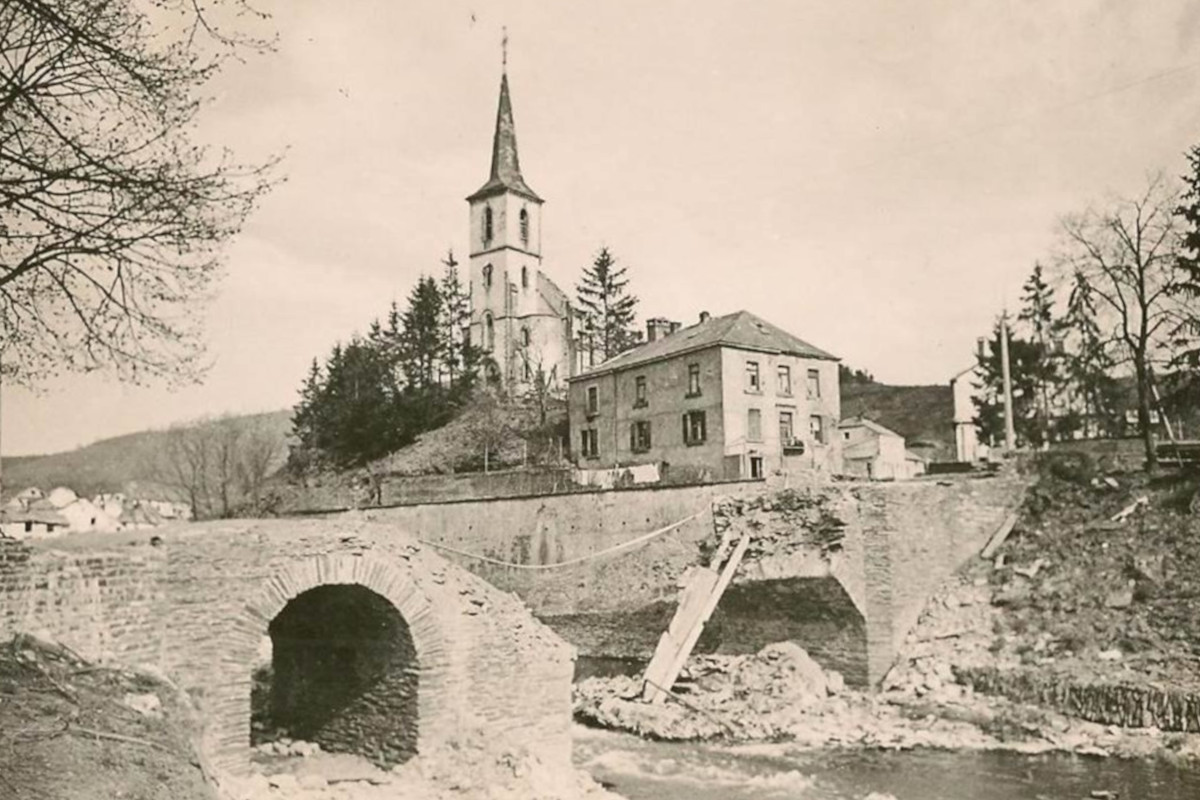
On Christmas Eve a house is strafed by an aircraft. On St Stephen’s Day the church is destroyed by a single bomb. On 28 December there is another bombing raid, in which the shed next to the school is hit.
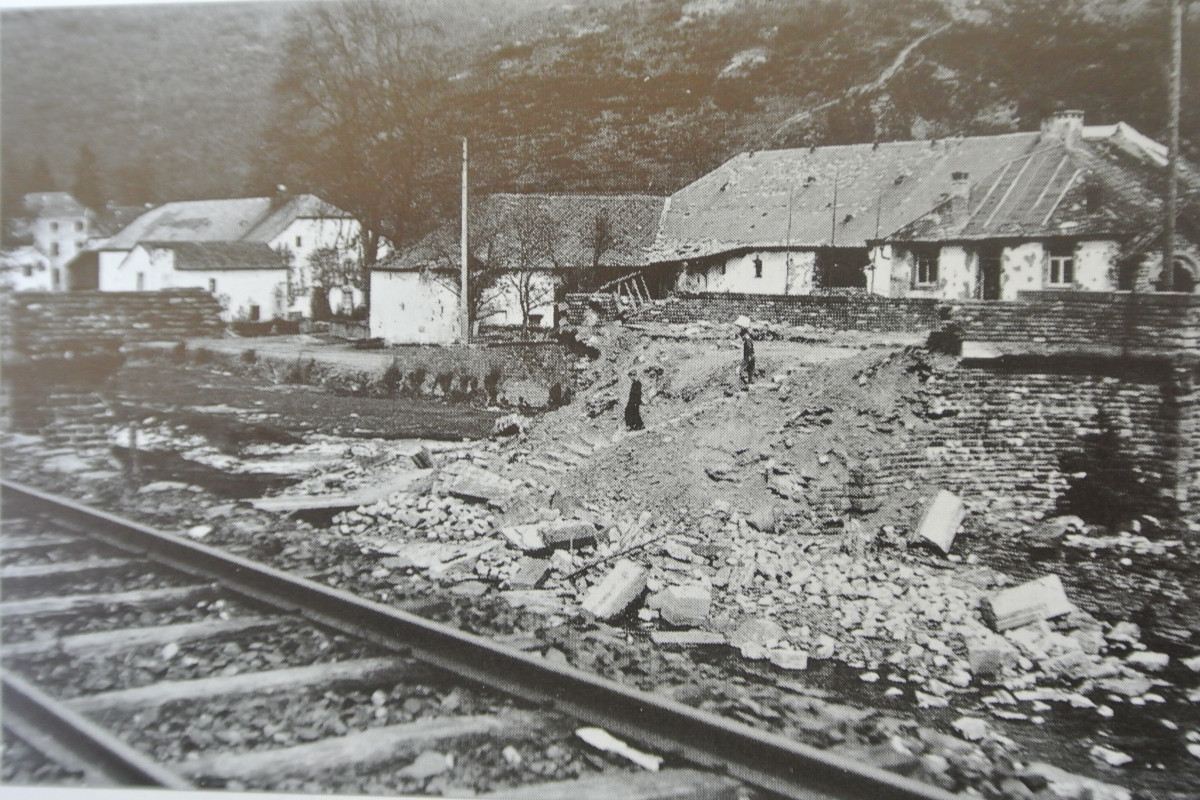
On 23 January 1945 the 319th Regiment of the US Army’s 80th Infantry Division crosses the river Wiltz between Merkholtz and Kautenbach and takes Kautenbach on 24 January. After blowing up the bridges, the German soldiers withdraw. They take up positions at the edge of the village and on the steep slopes towards Consthum and shell the village.
The 18-year-old German front-line soldier Heinrich Koning recalls (translated from German): “I belonged to the 2nd Battalion of the 226th Regiment of the 79th Volksgrenadier Division. Around 25 January I was taken prisoner in Kautenbach with seven soldiers from our group. We were supposed to cover the retreat of the 79th Volksgrenadier Division and were by the church, in the first house on the left of the road to Consthum. Two engineers who had come to lay tripwire mines were shot immediately. We laid down our weapons and came out carefully with our hands up. We were taken prisoner and interrogated in a large house …”
On 14 January some 70 inhabitants of Nocher are forced to leave their village. They resist and try by every means to stay. But the German soldiers show no mercy. It is about six kilometres from the heights down to Kautenbach. The descent is easy at first, but the rest of the way through the hedges is very hard going: the elderly, women and children slip, fall into the snow, huddle by the roadside. The German soldiers drive them on, and at around 3 am the group reaches Kautenbach. They seek shelter in the station cellar, but like almost all cellars it is overcrowded. Finally they find a cellar by the stream – ice-cold and damp.
The march is actually supposed to continue the next day. The prisoners are threatened and are only allowed to stay when six men agree to dig trenches. So 70 people live for two weeks crammed together in a cellar in Kautenbach. Finding food for so many people in wartime, and in winter at that, is a real challenge. On 27 January, half-starved, they return to Nocher, which after heavy fighting is nothing but a field of rubble. No food, no clothes, no proper roof over their heads ‒ this is what misery looks like.
In Kautenbach, too, the war claims civilian victims. On 8 January 14-year-old Martin Mersch is hit in the head by a shell splinter near the Peysen house and dies. Forty-year-old Pierre Wickler can hardly wait for the GIs to arrive. He comes out of his hiding place in the woods waving a white flag and is killed by an American bullet. On 28 December a baby is born who dies as a result of the cold.
During the night of 2 to 3 February a four-engined British bomber crashes about 100 metres from the school. The force of the explosion is enormous and causes further destruction. Seven Britons are killed. The wreckage of the aircraft lies scattered across the gardens between the Clerve and the village street.
During the Rundstedt Offensive two houses are completely burnt out, four destroyed and three rendered uninhabitable. Throughout the village, windows and roofs are damaged. Only the tower of the church is still standing; even in the hard year of 1945 its bells still call people to prayer. At the end of January 1945 the retreating German troops blow up all the railway bridges on the Kautenbach-Wiltz line.
Reconstruction of the badly hit village begins soon after the end of the war. On 2 May 1945 Grand Duchess Charlotte visits the devastated village of Kautenbach to see the situation for herself and give the people courage. In the same month the blown-up bridge over the Wiltz is rebuilt. On 23 June 1945 train services between Kautenbach and Wiltz resume.




Further information
Sources & photos
› Jean Milmeister - Die Ardennenschlacht
› Fritz Rasqué - Das Ösling im Krieg
› Biller aus der Gemeng Kautebach 1991
› De Cliärrwer Kanton - Erzählungen von Frau Wagener-Weis Marthe
› The National Archives and Records Administration (NARA)
› Website Aircrew Remembered


